How to Keep Your Real Number Private While Dating Online (2026 Guide)
Your phone number unlocks your name, address, and accounts. When to move off the dating app, what to give a match instead of your real number, and how to set it up in 60 seconds.
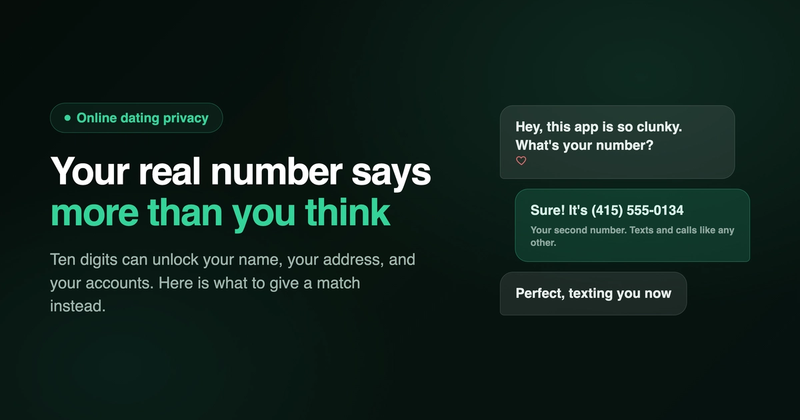
It usually happens somewhere between the third and the tenth message. The conversation is going well, the jokes are landing, and then the little bubble appears: "This app is annoying, what's your number?"
And here's the thing. It's a completely normal request. Most good conversations do eventually move off the app. But the moment you type your real number into that chat, you've handed a stranger something far more permanent than a match. You can unmatch a person. You can block a profile. You cannot unsend a phone number.
Around three in ten American adults have used a dating app, according to Pew Research, so this exact moment plays out millions of times a day. Almost nobody pauses at it. This guide is about what that number actually reveals, when it makes sense to move off the app, and the simple setup that lets you text and call a match like a normal person without giving away the key to your real life.
Here's what we'll cover:
- What a stranger can actually do with your phone number (it's more than you think)
- Why "just stay in the app forever" is advice nobody follows
- The escalation ladder: what to share at each stage of talking to someone
- How to set up a private second number for dating in about 60 seconds
- The red flags that mean you should never move off the app at all
What a Stranger Can Actually Do With Your Phone Number
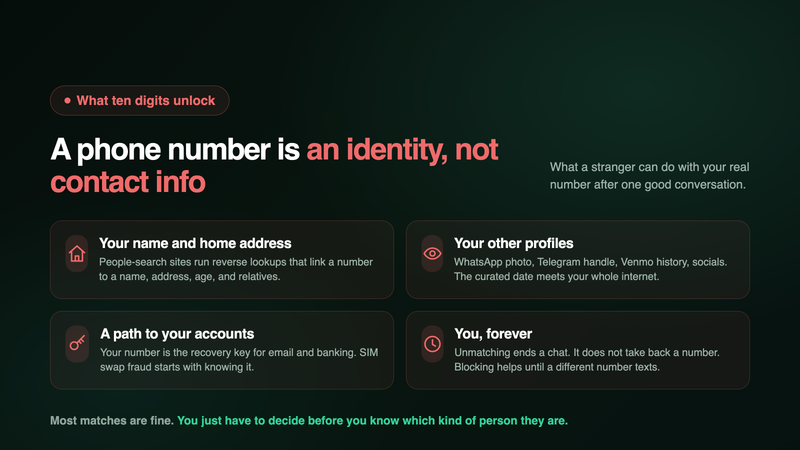
Most people think of their phone number as contact information. In 2026, it's closer to a universal ID. Here's what someone holding your ten digits can do with them.
Look up your full name and home address. People-search sites (Whitepages, Spokeo, BeenVerified, and dozens more) run reverse phone lookups that link a number to a name, current address, previous addresses, age, and relatives. Some charge a few dollars. Some are free. A match you've known for forty minutes can know where you live before the first date. That is not a hypothetical; it's the standard product these sites sell.
Find every account attached to it. Your number is the recovery key for your email, banking, and social accounts, and it's often searchable inside apps too. Someone with your number can frequently surface your WhatsApp photo, your Telegram handle, your Venmo history, or a Facebook profile you never mentioned. The date you carefully curated on the app now has your entire unfiltered internet presence.
Attack the number itself. SIM swap fraud, where someone convinces a carrier to move your number to their SIM, starts with knowing the number. It's rare in a dating context, but the accounts that fall when it happens (email, bank, everything that texts you a code) make it the worst-case scenario. We covered how verification and number security actually work in our guide to whether second phone number apps are legal and safe.
Reach you forever. This is the everyday risk, and the one that actually happens. The date goes nowhere, you unmatch, and three weeks later a text arrives at 1am. Blocking helps until they use a different number. Your real number follows you across every app, every job, every year. Once one person has it, you can't take it back without changing it everywhere.
None of this means the person asking for your number is dangerous. Almost all of them are just people who find app messaging clunky. The problem is that you have to decide before you know which kind of person they are.
"Just Stay in the App" Is Advice Nobody Follows
Every dating platform tells you the same thing: keep conversations in the app as long as possible. Tinder's own safety guidelines say to maintain conversations on the platform and take your time before sharing contact details. It's good advice, and there's a reason the apps give it: their messaging keeps your identity walled off, and their moderation can see reported conversations.
But let's be honest about how dating actually works. App messaging is where conversations go to die. Notifications get buried. Some apps limit messages or push you to pay to keep talking. Voice calls before a first date (genuinely one of the best screening tools there is) usually aren't possible in the app at all. Sooner or later, every promising conversation faces the same jump to real texting.
So the practical question was never "should I move off the app?" It's "what number do I move to?"
Give your real number, and you're trading your permanent, everything-attached identity for the convenience of iMessage. Refuse entirely, and plenty of good matches will quietly read it as disinterest. The answer that doesn't force that trade is the one privacy-conscious daters have been quietly using for years: a second phone number that texts and calls like any other number but isn't wired to your identity.
The Escalation Ladder: What to Share, and When
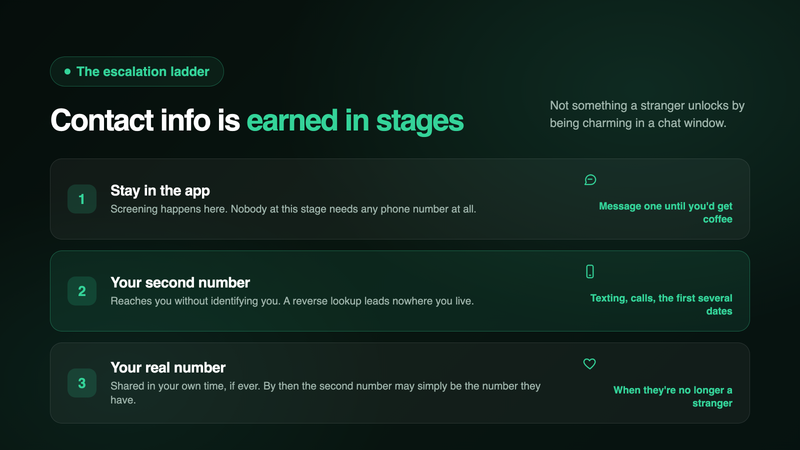
Think of contact information as something a person earns in stages, not something they unlock by being charming in a chat window.
Stage 1: In the app (message one until you'd get coffee). Screening happens here. You're checking that they can hold a conversation, that their photos match a real person, that nothing feels off. There is no reason anyone at this stage needs any phone number at all. If they push hard for one anyway, that itself is information (more on that below).
Stage 2: Your second number (texting, calls, the first several dates). When a conversation is worth continuing, hand over a number that reaches you without identifying you. A real, dedicated number that does everything texting and calling should do, with one difference: a reverse lookup on it doesn't lead to your name, your address, or your other accounts. If the person turns out to be wonderful, they had a real number the whole time and never noticed anything. If they turn out to be a 1am texter, they have exactly ten digits that lead nowhere.
Stage 3: Your real number (when they're no longer a stranger). Some people share it after a month. Some after six. Some never bother, because by then the second number simply is the number their partner has, and there's nothing to fix. The point of the ladder is that this becomes a choice you make in your own time, not a toll you pay to keep a conversation alive.
If this staged approach sounds familiar, it's because it's the same tactic sellers use to survive Facebook Marketplace and Craigslist without getting spammed. Strangers get the buffer number. People who earn trust get more.
Setting Up a Private Dating Number in About 60 Seconds
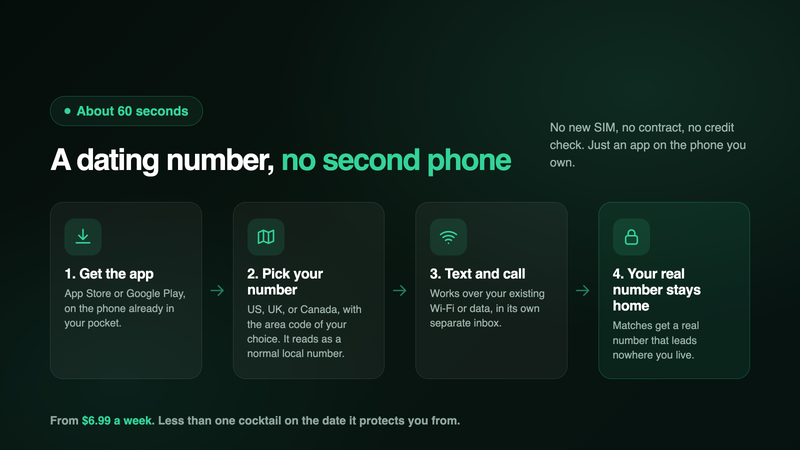
A second number used to mean carrying a second phone, or wrestling with Google Voice (which, as we've covered in our Google Voice alternatives guide, doesn't officially exist outside the US). Today it's an app install. With Inovo Second Number, the whole setup looks like this:
- Download the app from the App Store or Google Play.
- Pick your number. US, UK, or Canadian, and you choose the area code. Matching your city makes it read as exactly what it is: a normal local number.
- Start texting and calling. The number works over your existing Wi-Fi or data. No second SIM, no second phone, no new contract. (Curious how that works? Here's how a phone number can exist without a SIM card.)
- Give that number to matches. Everything arrives in the app, in its own inbox, clearly separated from your personal messages.
Plans start at $6.99 a week, with monthly ($19.99) and yearly ($49.99) options if dating apps are a longer-term part of your life. That's less than one cocktail on the mediocre date this number will protect you from.
Two honest caveats, because we'd rather you know them now. First, this is a privacy layer, not an anonymity cloak: the number is registered to you with the provider, which is exactly why it stays legal and why abuse can be acted on. Second, if you also plan to use the number for account sign-ups, a few strict platforms detect and refuse app-based numbers; here's what to do when a website won't accept a VoIP number. For texting and calling another human being, none of that applies. It's just a number.
When a Match Turns Weird: Your Exit Plan
The quiet luxury of a second number is how boring bad outcomes become.
If someone won't stop texting: block them in the app. Your real number was never in play, so there's nothing to leak, nothing to change, and no anxiety about where else those ten digits might surface.
If the number itself gets too noisy: retire it. Because your dating life lived on its own number, you can swap that number without re-printing business cards, updating your bank, or texting forty friends. Your real number never moved.
If someone reverse-searches you: they find nothing that leads home. This is the scenario the whole setup exists for, and it fails safely.
Compare that to the real-number version of the same story, which involves screenshotting harassment, considering a carrier-level number change, and updating every account you own. The difference isn't subtle.
Red Flags That Mean You Should Never Move Off the App
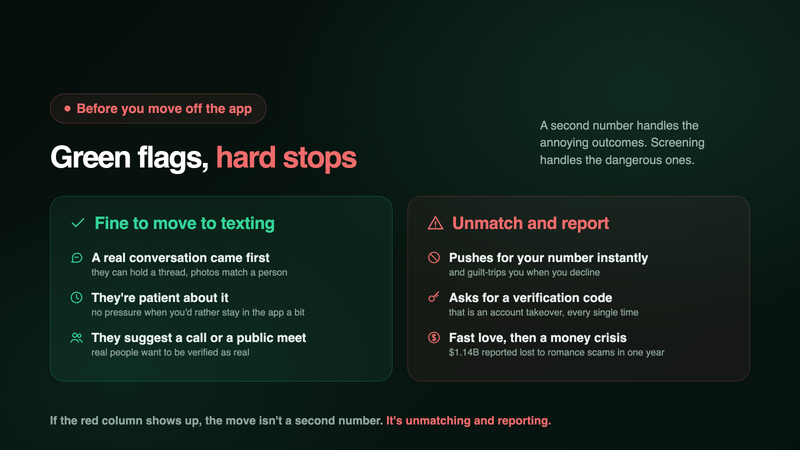
A second number protects you from the annoying majority of bad outcomes. It does not make risky people safe, so the screening stage still matters. A few patterns are worth treating as hard stops:
- They push for your number in the first few messages, and get irritated or guilt-trip you when you'd rather keep chatting in the app. Patient people take no for an answer. Scammers work in volume and hate slow marks.
- They ask you to send them a verification code "to prove you're real." This is a takeover of whatever account that code belongs to, every single time. No exceptions. Hang up on it mentally and report the profile.
- They fall in love fast, and then a crisis needs money. Romance scams follow this arc so reliably that the FTC publishes the script. Reported losses hit $1.14 billion in 2023, with a median loss around $2,000, the highest of any imposter scam. The tell is always the same: intense feelings, elaborate excuses never to video call or meet, and eventually a payment request (gift cards, wire transfer, crypto).
- Nothing about them survives a light search. Photos that reverse-image-search to someone else's profile, a job and city that keep shifting, a profile created last Tuesday. You're allowed to check. They checked you.
If any of these show up, the move isn't a second number. The move is unmatching and reporting them so the next person swipes past a warning instead of a trap.
The Bottom Line
Moving from the app to real texting is a normal, healthy step in online dating. Handing a stranger the number that unlocks your name, your address, and your accounts is not the required price for it, and it never was.
Keep the early screening inside the app. When a conversation earns the next step, give out a second number that texts and calls like any other but leads nowhere you live. Save your real number for people who have long since stopped being strangers. That's the whole system, and it takes about a minute to set up.
Get your private dating number on the App Store or on Google Play, pick a local number, and let the next "what's your number?" be an easy question.
And if you're still comparing your options first, our full guide to getting a second phone number in 2026 walks through every route, including the free ones.