Are Second Phone Number Apps Legal and Safe? What Actually Happens to Your Texts
Second phone number apps are legal in the US, UK, and Canada, but legal and safe are not the same thing. Here's how they work, what happens to your texts, and how to spot a provider you can trust.
Before you install an app that will carry your calls and texts, it's worth pausing to ask two blunt questions. Is this legal? And is it safe?
Good instinct. An app that gives you a working phone number in a minute can feel almost too easy, and "burner number" doesn't exactly sound like something your lawyer suggested. So let's answer both questions properly, without marketing fog.
The short version: yes, second phone number apps are legal in the US, UK, and Canada, and the good ones are safe. But "the good ones" is doing real work in that sentence. This article explains how these apps work under the hood, what actually happens when you send a text, what the law does and doesn't allow, and how to tell a trustworthy provider from a sketchy one.
Are Second Phone Number Apps Legal? Yes, and Here's Why
There is no law in the US, UK, or Canada against owning more than one phone number. There never has been. Businesses have run multiple lines for a century, and nobody has ever been arrested for having a work phone.
What a second number app does is technically ordinary: it provides you a real phone number through VoIP (voice over internet protocol), the same technology behind Skype, WhatsApp calling, Zoom, and most modern office phone systems. These numbers come from the same regulated pools as every other phone number, allocated by licensed carriers and overseen by the same regulators that oversee your mobile network:
- United States: the FCC regulates VoIP services and number allocation.
- United Kingdom: Ofcom manages the numbering plan that VoIP numbers are issued from.
- Canada: the CRTC oversees numbering and telecom rules.
In other words, a number from a legitimate app is not a fake number. It's a real number, from the real numbering system, delivered through an app instead of a SIM card. (If you're curious how a phone number can exist without a SIM at all, we've explained the plumbing in how to get a second phone number without a SIM card.)
So what's actually illegal?
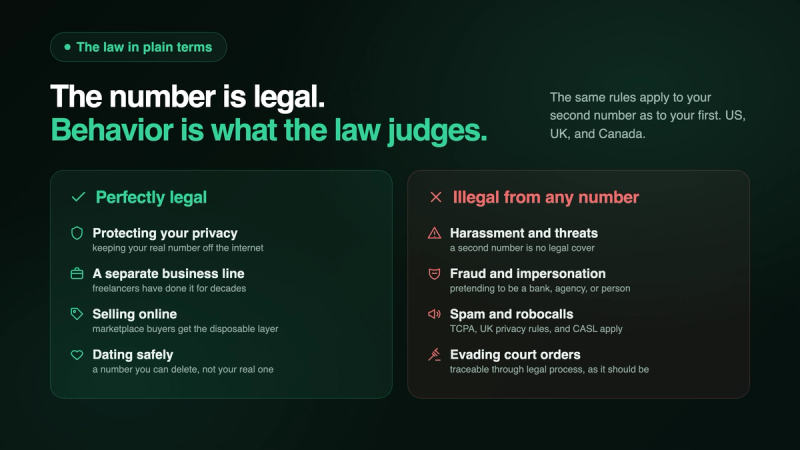
The law cares about what you do with a number, not how many you have. The same rules that apply to your main number apply to your second one:
- Harassment and threats are illegal from any number.
- Fraud and impersonation (pretending to be your bank, a government agency, or another person) are illegal from any number.
- Spam and robocalls are restricted everywhere: the TCPA in the US, privacy regulations in the UK, and CASL in Canada all limit unsolicited marketing calls and texts.
- Evading a court order (for example, contacting someone a restraining order says you can't) is illegal no matter what number you use.
A second number doesn't launder any of that. Which brings up a point that surprises people, and that we think providers should be honest about.
Private is not the same as anonymous
A second number protects your privacy from other people: the marketplace stranger, the dating match you just met, the client who texts at 10pm. It does not make you invisible to the law.
Legitimate providers verify accounts, keep the records the law requires them to keep, and cooperate with valid legal requests, exactly like every phone carrier does. If someone uses a second number to commit a crime, that number can be traced back to them through legal process.
We consider that a feature. An app that genuinely offered criminals untraceable numbers would be an app full of criminals, and its numbers would be blocked, flagged as spam, and useless for everyone else. The reason a number from a trustworthy provider works reliably for normal life is precisely that the provider doesn't tolerate abuse on its network.
Are They Safe? What Actually Happens to Your Texts
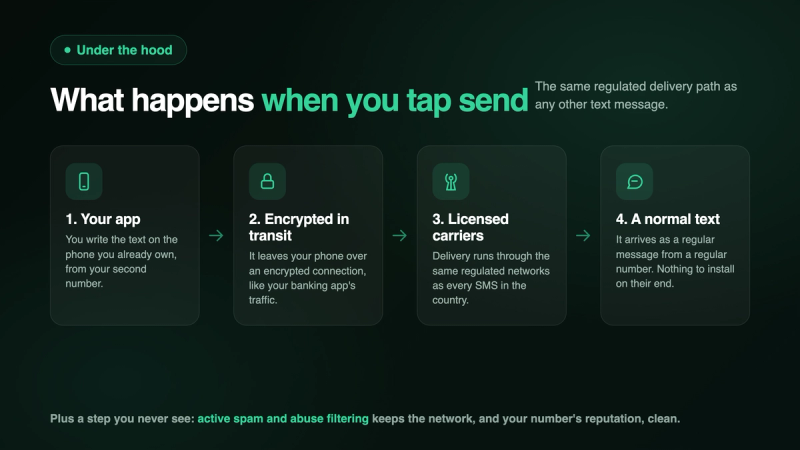
Legality is about the law. Safety is about the app. When you tap send on a text, here's what actually happens with a legitimate provider like Inovo Second Number:
- Your message leaves your phone over an encrypted connection. Traffic between the app and the servers is encrypted in transit, the same way your banking app's traffic is. Nobody snooping on cafe Wi-Fi is reading your texts.
- It's handed to licensed carrier infrastructure. The message is delivered through the same regulated carrier networks that handle every other SMS in the country. It arrives on the other person's phone as a normal text from a normal number.
- Your account stays yours. Inovo signs you in with your Google or Apple account, which means your access is protected by the strongest consumer security that exists (including any two-factor protection you've enabled there). There's no separate password to leak.
And one step most people never see:
- Abuse gets filtered. Inovo runs active moderation on its network: spam detection, sending limits, blocklists, and automated screening that flags and stops abusive messaging patterns. Accounts that use the service to harass or scam get suspended.
That last point deserves a beat, because it's the part that makes the whole system safe for you. Moderation isn't surveillance of your conversations; it's the reason your number hasn't been poisoned by someone else's behavior. When a provider lets spammers run wild, its number ranges get flagged by carriers, and suddenly innocent users find their texts silently undelivered and their calls labeled "Scam Likely." A clean network is a safety feature you feel every time your message simply arrives.
What a second number protects you from
Here's the practical safety math. Your main personal number is likely attached to your bank, your WhatsApp, your email recovery, and a decade of accounts. Every time you hand it to a stranger or type it into a website, you extend that attack surface:
- Data breaches. When a site you gave your number to gets breached, your real number lands in leaked databases, tied to your name and email.
- SIM swap attacks. Scammers who collect enough of your details can try to hijack your main number and, through it, your accounts. The less public your real number is, the harder that gets.
- Spam and scam calls. Numbers published online get scraped and sold. That's the business model of data brokers, and it's why your phone rings about car warranties.
- People you'd rather un-meet. A marketplace buyer or a first date gets a number you can delete, not the number your family uses.
A second number is a firewall: strangers and websites get the disposable layer, and your real number stays known only to people you trust. If that's the main reason you're here, our guide to getting a second phone number in 2026 covers the use cases in depth.
How to Spot a Provider You Can Trust (and the Red Flags)
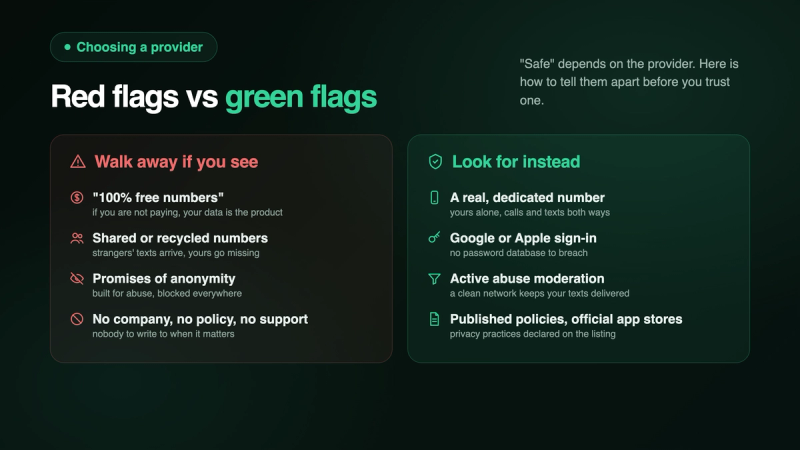
Not every app in the store deserves your calls and texts. The category has a long tail of free apps with real problems, and this is where "are these apps safe" gets its honest answer: some aren't. Here's how to tell.
Red flags:
- "100% free numbers." Running real phone numbers costs real money, paid to carriers. If you aren't paying, the business model is usually your data: ad tracking, or worse, selling activity data. Free numbers are also heavily recycled and frequently flagged as spam.
- Shared or recycled numbers. Some services hand the same number to multiple users, or re-issue numbers minutes after someone drops them. That means missed texts meant for strangers, and strangers getting texts meant for you.
- Promises of anonymity. As above: a provider advertising untraceable numbers is advertising to the wrong crowd, and its network reputation will make your life worse.
- No company behind the curtain. No published privacy policy, no support contact, no legal entity you can find. If something goes wrong, there's nobody to write to.
- Numbers that fail verification everywhere. Heavily abused number ranges get blocked by banks and major platforms. (Some sites restrict VoIP numbers regardless of provider; that's a real limitation of the category and worth knowing before you rely on one for account sign-ups.)
Green flags:
- A real, dedicated number. Yours alone, for as long as you keep it. Calls, texts, and picture messages both ways.
- An honest paid model. You're the customer, not the product. The economics are simple and public.
- Sign-in through Google or Apple. No password databases to breach.
- Active abuse moderation. The provider visibly cares about keeping its network clean, which keeps your number deliverable.
- A published privacy policy and reachable support. A company that expects to be around next year behaves like it.
- Distribution through official app stores. App Store review isn't a rubber stamp; payment handling, privacy declarations, and content moderation all get scrutinized.
Inovo Second Number is built to sit on the right side of every line above: dedicated US, UK, and Canadian numbers, Google/Apple sign-in, active network moderation, and a straightforward paid model with no data selling. You can see it on the App Store, where the privacy practices are declared right on the listing.
The 60-Second Version
- Legal? Yes. Second phone number apps provide real, regulated numbers over VoIP. Owning multiple numbers is and always has been legal in the US, UK, and Canada.
- What's illegal is behavior, not the number: harassment, fraud, spam, and impersonation are illegal from any number, and a second number provides no legal cover.
- Private, not anonymous. A good provider shields your real number from strangers and websites, while still cooperating with lawful requests like any phone company. That honesty is why its numbers keep working.
- Safety depends on the provider. Encrypted connections, dedicated numbers, Google/Apple sign-in, and active spam moderation are the marks of a safe one. "Free," shared, and "untraceable" are the marks of the other kind.
Get a private second number on the App Store
FAQ
Is it legal to have two phone numbers?
Yes, completely, in the US, UK, Canada, and essentially everywhere else. There's no limit on how many phone numbers a person can hold. Businesses and professionals have done it for decades; apps just made it cheap and instant.
Are burner number apps legal?
Yes. "Burner" is marketing shorthand for a number you can drop when you're done with it, not a legal category. The numbers come from the same regulated system as every other number. What's illegal is using any number, temporary or not, for harassment, fraud, or spam.
Can a second phone number be traced back to me?
Through legal process, yes. Legitimate providers keep the records the law requires and respond to valid legal requests, just like mobile carriers. Your privacy is protected from other people (strangers, websites, data brokers), not from courts. For everyday use, that distinction is exactly what you want: privacy without joining a network of scammers.
Is it legal to use a second number for dating or selling online?
Yes, and it's smart. Keeping your real number away from strangers is basic safety, not deception. You're reachable at a real number; you've just chosen which one.
Can someone read my texts?
Messages travel between the app and the delivery network over encrypted connections, so they can't be casually intercepted in transit. Standard SMS (from any provider, including your main carrier) is not end-to-end encrypted, so treat texting the same way you always have: fine for everyday life, not the place for your passwords.
Why do some websites reject virtual numbers for verification?
Some platforms restrict VoIP number ranges to limit fake account creation, and ranges abused by free apps get blocked most aggressively. Numbers from paid providers with clean networks fare much better, but no provider can honestly promise acceptance everywhere.
Do these apps sell my data?
Some free ones effectively do; that's how "free" gets paid for. Inovo's model is the boring one: you pay for the service, and the service is the product. Privacy practices are declared on the App Store listing.
What happens to my number and texts if I cancel?
When you release a number, it's retired from your account and, after a quarantine period standard in the industry, eventually returns to the carrier pool. Anything you want to keep, save before you release the number. Your personal number is never involved either way.
Inovo Second Number gives you a real US, UK, or Canadian phone number in about 60 seconds. Calls, texts, and picture messages, with your personal number kept private and a network that's actively kept clean. Download it on the App Store.