Gave Your Number to a Match and Regret It? Here's What to Do Next
Regret giving a dating match your real number? Block, report and lock your carrier account in 10 minutes, and know when it is time to report a scam.
If you regret giving a match your real number, block the number on your phone, unmatch and report them in the dating app, and screenshot anything worrying first. Then turn on your carrier's free SIM and number lock and never share a code they send you. Most of the time that ends it; if it turns into threats or money requests, report it to the police and the FTC (US) or the Canadian Anti-Fraud Centre.
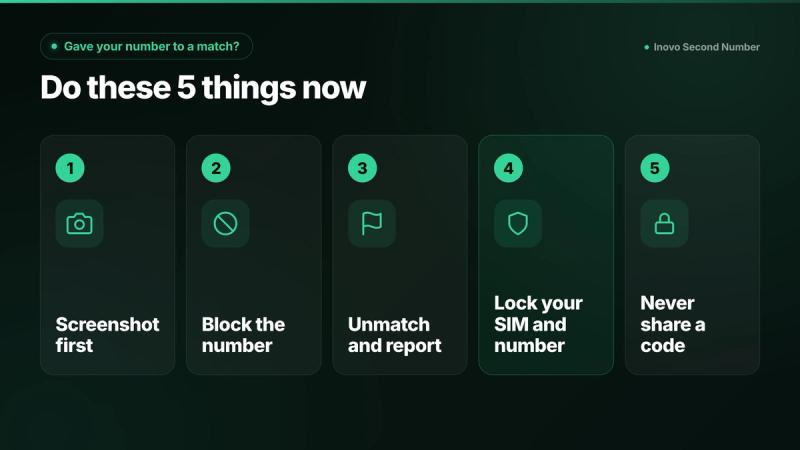
Do these 5 things now
- Screenshot first, so you keep the evidence.
- Block the number on your phone.
- Unmatch and report them in the dating app.
- Lock your SIM and number with your carrier's free account lock.
- Never share a code they ask for.
It probably started with "Can I get your number?" Now the chat feels off, or you just want out. If you gave your number to a match and regret it, that is fixable. This is the follow up to our second phone number for dating guide, for when your real number is already out there, in the US or Canada.
What can someone actually do with just your phone number?
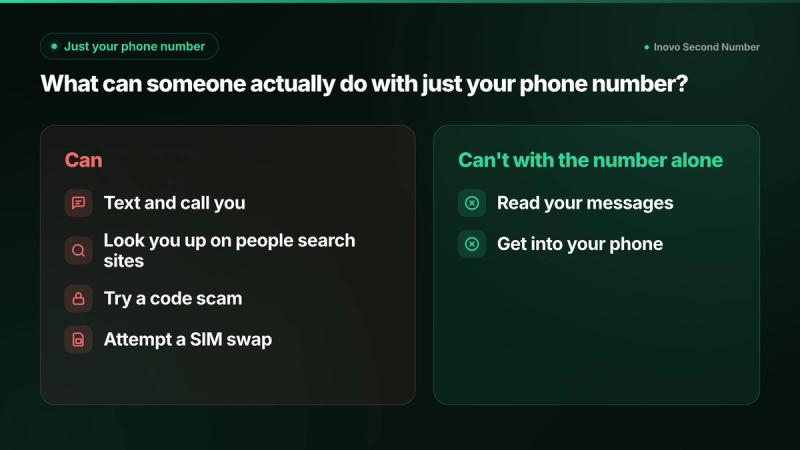
Less than you fear. Keeper Security lists phishing, spam calls, spoofing and SIM swapping as the main risks. Someone with your number can:
- Text and call you, including from new numbers after you block them.
- Look you up on people search sites, which, per Keeper, can turn a number into "your full name, age, home address and more" from public records.
- Find your social profiles if your number is linked to them.
- Try a code scam, asking you to read back a code that was texted to you.
- Attempt a SIM swap, in rare cases, by talking your carrier into moving your number to their SIM.
What they can't do with the number alone: read your messages or get into your phone. Keeper notes that message reading malware arrives through a link you click. For what a number reveals, see who can trace a second phone number.
Should you block them, or tell them first?
You never owe an explanation. If you want closure, send one short message, then block:
"Hey, I don't think we're a match. Please delete my number. Take care."
If they text from a new number, block that too and screenshot each. Hearts Again warns that once someone has your number, "they could try again from a different number." Save that pattern for any report.
How do you block a number on iPhone and Android?
Steps from each company's help page, as of 29 Oct 2026:
iPhone (Apple's guide):
- In Messages, open the conversation, tap the contact at the top, then tap Block Caller.
- In Phone, tap Recents, tap the number, then tap Block Caller.
- Apple says blocked contacts can still leave a voicemail, but you won't be notified, and they are not told.
- You can also filter iMessages from unknown senders.
Android (Google's Phone app guide):
- Open the Phone app, tap More, then Call history, tap a call from the number, then tap Block / report spam.
- To block private or unidentified callers, go to Settings, then Blocked numbers, and turn on Unknown.
- Google notes you will still get calls from numbers that are not in your contacts.
- These steps are for the Phone by Google app; other phone apps differ.
Should you unmatch and report them on the dating app?
Yes, even after you moved to texting. A report reaches the app's safety team. Bumble's privacy guide says members can report people who ask for personal information, "like a phone number, email, or physical address," and tells you to "Unmatch them or Block & Report them" if a match pressures you.
Reporting protects the next person. The FBI's IC3 says to "report suspicious user profiles to the dating site administrator." On Hinge, Tinder or any other app, report before you unmatch, since the chat may disappear after.
Next time, Bumble has "a Video Chat and Voice Call feature that you can use with a match so you don't have to disclose any personal information."
How do you protect your number from a SIM swap?
A SIM swap moves your number to someone else's SIM; port out fraud moves it to another carrier. Either way, your codes go to them. It is rare, but the lock takes minutes.
In November 2023 the FCC adopted rules requiring US wireless carriers to offer customers, "at no cost," a lock that stops SIM changes and a lock that stops port outs. As of 29 Oct 2026, the federal rule text still shows the lock sections as reserved while compliance waits on a federal paperwork review. The FCC noted that several carriers already offer locks voluntarily, and the three largest do, for free:
- Verizon: Number Lock is free and stops your number being moved to another line or carrier. Dial *611, or use the Security page in My Verizon. It does not stop SIM changes, so also turn on SIM Protection, which Verizon says is at no cost, a separate setting in the My Verizon app.
- T-Mobile: T-Mobile calls SIM Protection and Port Out Protection free features. Port Out Protection is offered to Postpaid, Prepaid, Business and Metro by T-Mobile customers, and SIM Protection to Postpaid customers. Postpaid customers add them in the T-Life app or at T-Mobile.com.
- AT&T: Wireless Account Lock is "a free security feature" in the AT&T app (myAT&T): tap the person icon, then Wireless account lock. AT&T's 1 Jul 2025 announcement says the switch is for postpaid consumer accounts and blocks wireless number transfers and SIM swaps. Prepaid and business have separate locks.
- Canada: ask your carrier about an account PIN and protection against SIM changes and number transfers.
Also set a carrier PIN, a strong email password, and app based two step login.
What if they asked you for a verification code?
They text "send me the code so I know you're real," a code arrives, and if you read it back, they can use it to set up an account linked to your number. The FTC's October 2021 alert says that if you give scammers a Google Voice code, "they'll try to use it to create a Google Voice number linked to your phone number." Its rule for any code from someone you did not contact first: "That's a scam, every time."
If you already sent it:
- Google Voice code: Google's help page says you can disconnect your number from Google Voice if you were scammed into giving your code.
- Any other code: change that account's password and turn on two step login.
- A "verify" link: the FBI's IC3 warned on 26 Apr 2024 about matches sending a "free" verification link that collects your name, phone number, email and card number.
It hits sellers too; see our marketplace selling guide.
Can they find your address from your number?
Sometimes. People search sites match numbers to names, addresses and relatives. The FTC's guide to people search sites says you can opt out "on your own, one by one, for free," or pay a service to do it, and that your information "could re-appear" if your public records change.
- Search your own number to see what shows.
- Use each site's opt out, and check again now and then.
- Hide your number on social profiles.
If they show up at your home or you feel unsafe, call the police.
When is it a scam, harassment or a threat, and who do you call?
Signs it has moved past awkward:
- They ask for money, gift cards or crypto.
- They send a "verification" link or ask for a code.
- They threaten to share photos or messages unless you pay.
- They keep texting from new numbers after you said no.
What to do:
- Stop contact. The FTC's romance scam guide says to stop communicating "immediately."
- Save evidence: screenshots, numbers and dates.
- Do not pay. The FBI's 2023 sextortion warning on IC3 warns that "complying with malicious actors does not guarantee your sensitive photos or content will not be shared," and asks victims to keep all the details and report it.
- Tell your bank or payment company right away if you paid. The FTC's romance scam guide says to tell them you paid a scammer and ask them to refund your money.
- Talk to someone you trust, as the FTC suggests.
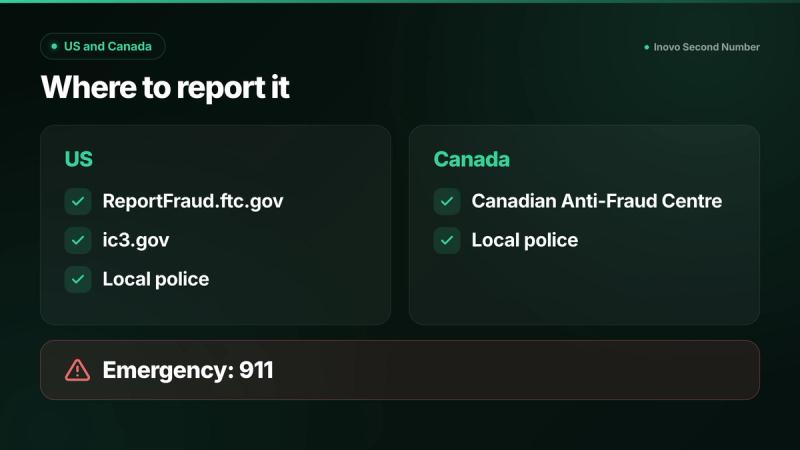
Where to report it:
- US: ReportFraud.ftc.gov, the FBI's ic3.gov, and your local police. The CFPB also lists your state attorney general.
- Canada: the Canadian Anti-Fraud Centre, online or toll free at 1-888-495-8501 (Monday to Friday, 10 am to 4:45 pm Eastern, as of 29 Oct 2026), and your local police.
- Emergency: 911, in the US and Canada.
Do you need to change your phone number?
Usually not. Blocking, reporting and the carrier lock handle most cases. A new number is worth it if contact keeps coming from many numbers or turns into threats.
The trade off is real: your bank, email recovery, work and friends all need the new number. That hassle is exactly why a separate number for new people helps next time.
How do you avoid this next time?
Keep early chat and calls in the app, then give a second number instead of your real one.
Our guide to a second phone number for dating covers the full method. Also see are second phone number apps legal and safe and how to get a second phone number.
Next time, give new matches an Inovo Second Number instead of your real one. It's a real US or Canadian number on the iPhone or Android you already have, for calls and texts with new people. If a number gets too noisy, you can stop using it while your main number never moved. Numbers are tied to active accounts. If your account is closed or your number expires due to inactivity, the number is released back to the carrier pool and cannot be recovered. Prices: see in app. Details are on our FAQ.
Download on the App Store · Get it on Google Play
FAQ
What can someone do with just my phone number?
They can text and call you, look you up on people search sites, find social profiles linked to the number, try a verification code scam, or in rare cases attempt a SIM swap. With the number alone they cannot read your messages or get into your phone. Block them and lock your carrier account.
Should I change my number after giving it to a match?
Usually not. Blocking the number, reporting the profile and turning on your carrier's SIM and number lock handle most cases. Changing is worth it if they keep contacting you from many numbers or make threats, but your bank, email recovery and friends all need the new number.
How do I stop a match texting me from different numbers?
Do not reply to any of them. Block each new number on your phone, keep screenshots with dates, and report the profile in the dating app. Blocking works one number at a time, so expect to repeat it. If the contact continues after you said no or includes threats, report it to your local police.
Can a match find my address from my phone number?
Sometimes. People search sites can link a phone number to a name, address and relatives using public records. Search your own number to see what shows, use each site's opt out to remove your listing, and hide your number on social profiles. If you feel unsafe, call the police.
What should I do if a match asked me for a verification code?
Do not send it. A code from someone you did not contact first is a scam, every time, according to the FTC. If you already sent a Google Voice code, use Google's page to disconnect your number. For any other code, change that account's password and turn on two step login.
Where do I report a dating scammer in the US or Canada?
In the US, report it at ReportFraud.ftc.gov and to the FBI at ic3.gov, and contact your local police. In Canada, report it to the Canadian Anti-Fraud Centre and your local police. Report the profile in the dating app too. In an emergency, call 911 in either country.
Is it rude to block someone without explaining?
No. You never owe a match an explanation, especially if they make you uneasy. If you want closure, send one short message such as "I don't think we're a match, please delete my number," then block. Do not reply to anything after that, and keep screenshots in case you need to report.
Related guides
- Free Second Phone Number: What's the Catch, and When Is Free Good Enough?Free second number apps are real, but they cost you in ads, lost numbers and blocked codes. Here is each app's catch, sourced, and when free is fine.
- Should You Put Your Phone Number on Your Resume? How to Stay Reachable Without the SpamYes, include a phone number. Here is which number to use, how to hide it on Indeed and LinkedIn, and how to spot job scam calls and texts.
- Google Voice Number Reclaimed? How to Get It Back, and What to Do If It Is GoneGoogle reclaims idle Voice numbers after about 3 months. You have 45 days to get yours back. Here are the steps, and what to do if the window has passed.

