Selling on Facebook Marketplace or Craigslist? Use a Burner Number
Handing a stranger your real number is the riskiest part of selling online. Here's the data on marketplace fraud, the verification code scam aimed at sellers, and how to sell with a burner number instead.
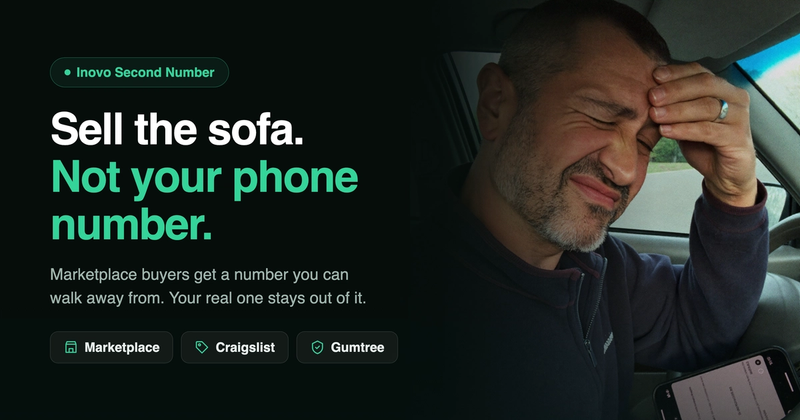
You list the sofa at 8pm. By 8:20 you have four messages. Three are "is this still available." The fourth says:
Hi, interested. Can you text me? What's your number?
And there it is. The most ordinary request in online selling, and the one moment where the whole transaction quietly stops being about the sofa.
Because the number you're about to type is not just a way to reach you. It's the number attached to your bank, your WhatsApp, your email recovery, your two-factor codes, and about a decade of accounts. You're handing it to someone whose profile you looked at for four seconds.
Most of the time, nothing happens. The buyer turns up, the sofa goes, everyone is happy. But "most of the time" is doing a lot of work in that sentence, and the data on what happens the rest of the time is worse than most sellers realise.
This guide covers:
- What the fraud numbers actually say about marketplace selling in 2026
- The verification code scam built specifically to harvest sellers' phone numbers
- The quieter risk: what a stranger can find out from your number alone
- Every common workaround, and exactly where each one breaks
- How to sell with a burner number instead, and the honest limits of that
Marketplace Selling Is Where the Fraud Is
Let's start with the honest scale of it, from sources that count rather than guess.
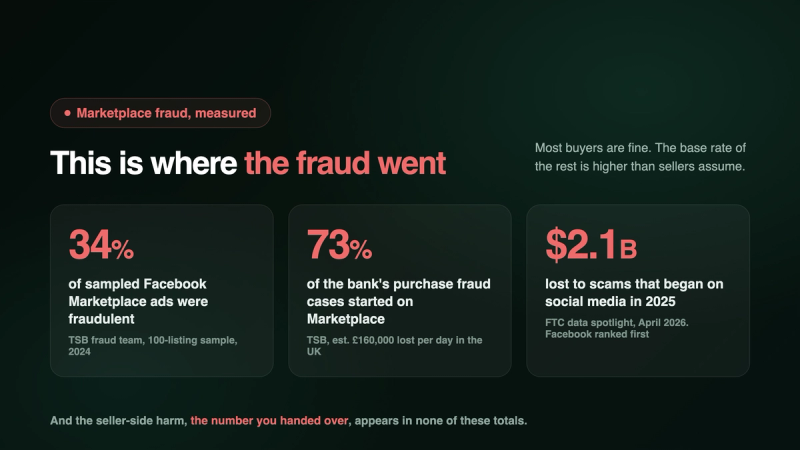
The FTC's April 2026 data spotlight found that Americans reported losing $2.1 billion to scams that started on social media in 2025. Nearly 30% of everyone who reported losing money to a scam said it began on a social platform, and losses through that channel have risen roughly eightfold since 2020. More people reported losing money to scams originating on Facebook than on any other platform, with WhatsApp and Instagram a distant second and third. Shopping scams were the single most reported type.
TSB's fraud team ran a field test on the platform itself. They sampled 100 Facebook Marketplace listings and engaged with the sellers to see whether the items were genuinely for sale. 34 of the 100 were fraudulent. In TSB's own case data, Facebook Marketplace accounted for 73% of all purchase fraud the bank saw, which it estimated at around £60 million lost by British consumers in a single year, roughly £160,000 a day.
Two things about those numbers matter for you as a seller.
First, this is a platform where a large minority of the counterparties are not real. Your instinct that "most buyers are fine" is probably still true. But the base rate of bad actors is high enough that you should assume a few of your inbound messages every month are from someone whose actual product is you.
Second, most published fraud statistics count buyers losing money, because that's what banks and regulators can measure. The seller-side harm is quieter and rarely shows up in loss totals: the number you gave out, the account that gets taken over months later, the address a stranger now knows. There is no clean statistic for "I gave a stranger my phone number and regretted it eleven weeks later." That doesn't mean it isn't happening. It means it isn't counted.
The Scam Built Specifically to Take Sellers' Numbers
If you only remember one thing from this article, make it this one.
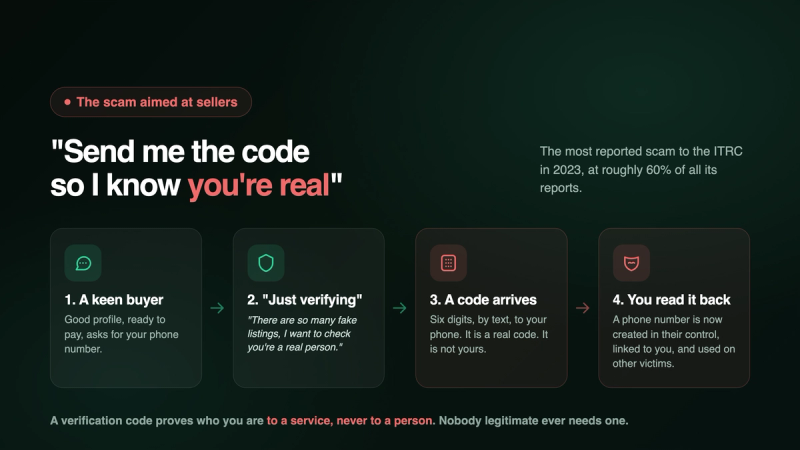
There is a scam that exists purely to harvest phone numbers from people selling things online. The Federal Trade Commission has an active consumer alert about it. The Identity Theft Resource Center reported that in 2023 it was the single most reported scam they received, at roughly 60% of all scam reports to the Center for the year.
It targets exactly you: people with a listing on Facebook Marketplace or Craigslist, and, in a detail that tells you everything about the people running it, people who have posted about a lost pet.
Here's the shape of it:
- The "buyer" makes contact and seems keen. Good message, plausible profile, ready to pay.
- They ask for your phone number, usually with a reason that sounds like caution rather than a demand: "There are so many fake listings, I just want to verify you're a real person."
- A six-digit code arrives on your phone by text. It looks like a verification code, because it is one. It just isn't yours.
- They ask you to read the code back to prove you're real.
If you read it back, you have just authorised the creation of a Google Voice number linked to your phone number, in their control. They now have a number that traces back to you, which they use to run scams on other people while wearing your identity. Some variants go further and use the same trick to seize accounts where your phone number is the recovery method.
Notice the elegance of the con. It inverts the safety instinct. You're being careful, they're being careful, and the act of "verifying" each other is the attack. Nobody asks you for money. Nothing feels like a scam until much later.
The rule that defeats it
A verification code is never proof of who you are to another person. It is proof of who you are to a service. There is no legitimate situation, ever, in which a stranger needs a code that was texted to your phone. Not a buyer, not a seller, not a landlord, not a delivery driver, not someone who found your cat.
If anyone asks for a code, that is the end of the conversation. Not a yellow flag. The end.
If you already gave one out
It happens, and it's fixable. Reclaim the number before it gets used:
- Go to voice.google.com and sign in with your Google account.
- Open Settings → Linked numbers → New linked number and enter your phone number.
- Request a fresh code, enter it, and confirm you want the number linked to your account. This unlinks it from theirs.
- Then secure the account it points at: change your Google password, turn on app-based two-factor authentication, and review recent account activity.
- Report it. In the US, IdentityTheft.gov and ReportFraud.ftc.gov. In the UK, Action Fraud. In Canada, the Canadian Anti-Fraud Centre.
And tell whoever else has been contacted from that number that it wasn't you.
The Quieter Risk: Your Number Is a Search Key
The code scam is dramatic. The everyday risk is duller and more common, and it's the reason experienced sellers stopped handing out their number long before they'd heard of any specific scam.
A mobile number is not a contact detail any more. It's an index key into a decade of leaked, brokered, and public data. Give a stranger ten digits and, with nothing more than a browser, they can typically make progress on:
- Your name. WhatsApp and many messaging apps will show a profile photo and display name to anyone who saves the number. That's often the first thing a "buyer" does.
- Where you live. Reverse lookup and people-search sites exist to link numbers to names and addresses, assembled from data brokers, marketing lists, and public records. They are frequently wrong, and frequently right enough. Remember that a marketplace buyer often has a rough idea of your neighbourhood already, because that's how you got matched.
- Your other accounts. Numbers are a common login handle and recovery method. Knowing yours is the first step in a takeover attempt, including SIM swap attacks where the goal is to receive your codes on their device.
- Everything from old breaches. Once your number lands in a leaked database alongside your name and email, it stays there. Removing yourself from broker sites is possible but tedious, and data reappears after removal often enough that privacy advocates treat opt-out as maintenance rather than a fix.
- A permanent spam entry. Numbers posted in classified ads get scraped. That's a business, not a theory.
The asymmetry is the point. You get one sofa sold. They get a permanent identifier that you can't rotate, because your real number is welded to your entire life. You can change a lock. You can't realistically change the number your mother, your bank, and 300 contacts have had for eight years.
Every Workaround, and Where It Breaks
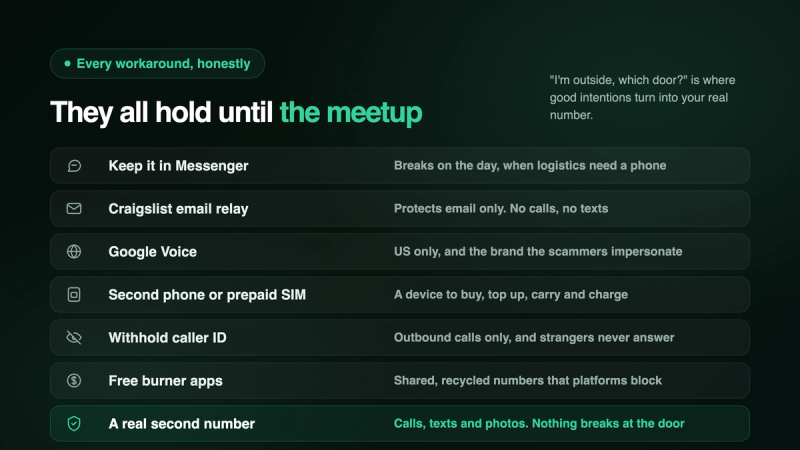
Sellers have invented plenty of ways around this. Most work partially. Knowing where each one breaks is more useful than a list of tips.
1. Keep everything in Messenger or the app's chat.
Genuinely good advice, and it's what every platform recommends. In-app chat keeps a record, and platform moderation can see it. It breaks at the meetup. On the day, there's a doorstep, a car park, a lost buyer, and a dead Wi-Fi connection, and "I'm outside, which door?" is a text message, not an app notification. That's the exact moment most people give out their number, having sensibly avoided it for a week.
2. Craigslist's anonymised email relay.
Craigslist has hidden real email addresses behind relay addresses for years, and it works well. But it's email, and it protects email. Once the conversation moves to arranging a time and place, people want a phone. The relay doesn't cover calls or texts.
3. Google Voice.
Free, and a real second number. Three limits. It's effectively US only, so it's not an option in the UK or Canada. It's the very brand attackers are impersonating, so some buyers are wary of it. And a growing number of platforms reject VoIP numbers for verification. We've written a full comparison in the best Google Voice alternatives in 2026.
4. A second phone or a prepaid SIM.
The traditional answer, and it works. It also means buying a device or SIM, topping it up, carrying it, charging it, and remembering it. For selling a bike once a year, that's a lot of overhead. If you're going down this route, our guide to numbers without a SIM card covers why most people no longer bother.
5. Withholding caller ID (dialling 141 or \*67).
Hides your number on outbound calls only. It does nothing for texts, does nothing when they call you, and withheld numbers mostly get ignored by strangers, which defeats the purpose when you're trying to sell something.
6. A free "burner" app from the app store.
Sometimes fine, often not. Free number apps tend to use shared or rapidly recycled numbers, which means texts intended for a stranger arriving on your screen and yours going missing. Their number ranges are also the most heavily abused, so they get blocked by platforms most aggressively. Since you're not paying, it's worth asking what is. We went through this in detail in are second phone number apps legal and safe.
The pattern across all six: the protections hold right up until the transaction gets real, and then they don't. What actually solves it is having a second real number that does everything your normal number does, and that isn't attached to anything in your life.
The Fix: A Dedicated Selling Number
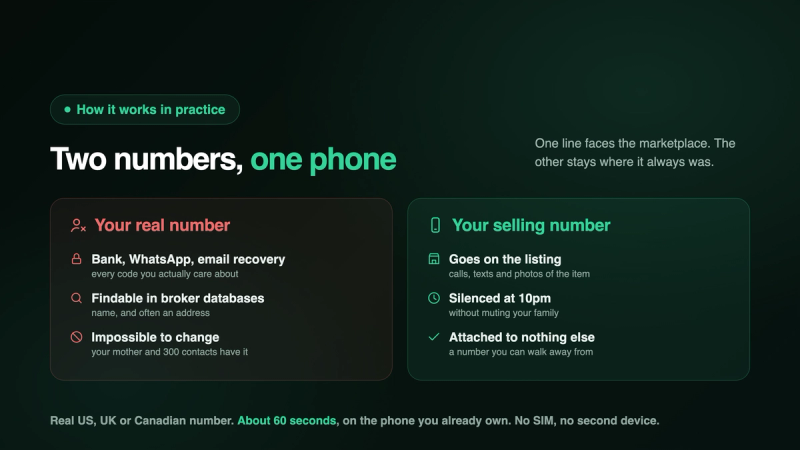
The setup that works is boring, which is why it works. You keep one second number as your public-facing number: the one that goes on listings, gets given to buyers, and takes the "I'm outside" text. Your real number stays known only to people you actually know.
With Inovo Second Number, that's a real US, UK, or Canadian number living in an app on the phone you already have. It takes about 60 seconds:
- Sign in with Google or Apple. No password to create or leak.
- Pick your country and choose a number from what's available.
- Subscribe, and the number is provisioned immediately.
From then on, buyers call and text that number. It rings on your phone, in the app, with its own notification. You can send photos of the item, take the call about whether the fridge fits in a Corsa, and answer the doorstep text. To the buyer it is a completely normal phone number, because it is one. Nothing to install on their end.
What that actually buys you:
- The listing number is disposable in principle, and your real one never is. If a number attracts spam or one buyer turns strange, that's a problem confined to a number you can eventually let go, not to your entire digital identity.
- Codes go where they should. Any verification for a selling account can land on the second number instead of your personal one.
- Separation of attention. Marketplace buyers text at odd hours. A separate line can be silenced at 10pm without muting your family.
- Your name doesn't come along. A number a stranger saves doesn't pull up your WhatsApp profile photo.
The honest limits
We'd rather tell you these now than have you discover them.
One active number at a time. An Inovo account holds one number, so this is a persistent selling line, not a fresh throwaway per listing. In practice that's what most sellers want, since your buyers need to reach you for more than a day. But if your mental model was "a brand new number for every sale," that isn't what this is.
It's a subscription, and the number depends on it. Plans start at $6.99 per week, with $19.99 monthly and $49.99 yearly. If the subscription lapses, the number is released back to the pool and can't be recovered. That's how numbers work everywhere. It's worth knowing before you put one on a listing you'll leave up for a year.
Some platforms restrict VoIP numbers for sign-up verification. This applies to the whole category, not to one app. Numbers from paid providers with clean, actively moderated networks fare considerably better than free recycled ones, but nobody can honestly promise acceptance everywhere.
Private is not anonymous. A second number keeps your real number away from strangers, websites, and data brokers. It is not a cloak. Legitimate providers keep the records the law requires and respond to lawful requests exactly like your mobile carrier does, which is precisely why their numbers still work and haven't been blocked into uselessness.
Seven Rules for Selling Without Getting Burned
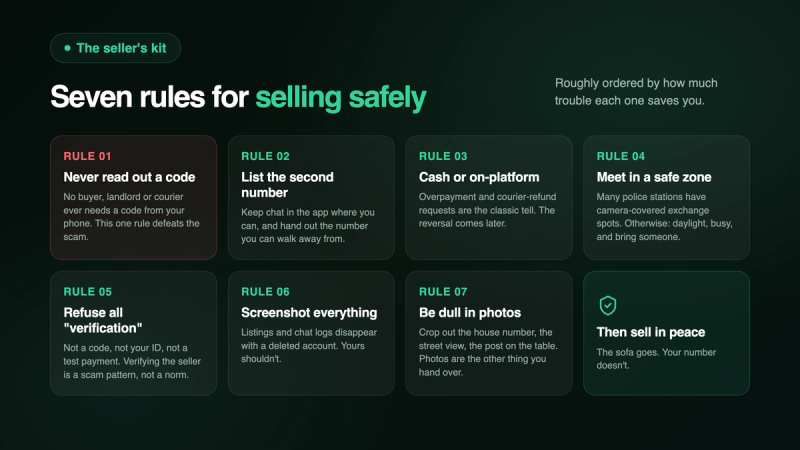
The number is one layer. Here's the rest of the kit, in rough order of how much trouble each one saves.
- Never read out a code. Ever. Covered above, and worth repeating because it is the single highest-value rule on this list. No legitimate buyer needs a code from your phone.
- Put the second number on the listing, not your real one. If the platform lets you keep contact in-app, do that too. The second number is for when the conversation has to leave the app.
- Keep payment on the platform, or take cash in person. Overpayment is the classic tell: a "buyer" sends too much, then asks you to refund the difference or cover a courier. The original payment is reversed later, the refund isn't. Anyone who insists on paying by an unusual method, or wants to send a courier for a local item, is telling you something.
- Meet in a safe exchange zone. Many police stations in the US, UK, and Canada have designated, camera-covered exchange spots. Failing that: daylight, busy, public, and bring someone. Don't have strangers come to your home, and if a large item makes that unavoidable, have another adult present.
- Don't let them "verify" you with anything. Not a code, not a photo of your ID, not a small test payment to your bank. Verification of the seller is a scam pattern, not a norm.
- Screenshot the listing and the chat. If something goes wrong, you'll want the record. Platform chat logs can vanish with an account.
- Be dull online. Photograph the item against a plain background. Crop out the house number, the street view through the window, the school uniform on the drying rack, the letter on the table. Your photos are the other thing you hand strangers.
The 60-Second Version
- Marketplace is where the fraud concentrated. The FTC recorded $2.1 billion lost to social-media-originated scams in 2025, with Facebook top of the platform list. TSB's sample found 34 of 100 Marketplace ads fraudulent, and Marketplace accounted for 73% of its purchase fraud cases.
- There is a scam aimed directly at sellers' phone numbers. A "buyer" asks for a code to verify you're real. Reading it back hands them a number linked to you. It was the most reported scam to the ITRC in 2023 at around 60% of all their reports. Never share a verification code with a person.
- Your number is an index key, not a contact detail. It links to your name, your accounts, your recovery options, and, through broker sites, often your address. You can't rotate it.
- The usual workarounds break at the meetup, which is exactly when people give in and hand over their real number.
- A dedicated second number solves the actual problem. Real number, real calls and texts, on the phone you already own, with your personal number kept out of it.
Get a second number for selling on the App Store or on Google Play
FAQ
Should I give my phone number on Facebook Marketplace?
Not your personal one. Platforms recommend keeping contact inside Messenger, and that's right as far as it goes, but almost every real sale ends with a phone call or a text on the day. The workable answer is to have a number you're happy to give out: a second number that reaches you but isn't attached to your bank, your WhatsApp, or your accounts.
What is a burner number, exactly?
"Burner" is shorthand for a number you can walk away from, not a legal category. It's a real, regulated phone number that just isn't tied to your identity the way your main line is. Owning more than one number is entirely legal in the US, UK, and Canada; we covered the legal detail in are second phone number apps legal and safe.
Can a buyer find my address from my phone number?
Sometimes, yes. People-search and reverse lookup sites compile numbers, names, and addresses from data brokers and public records. Accuracy varies wildly, but a marketplace buyer already knows roughly where you are from the listing, so the number often supplies the last piece. This is the main argument for not giving out the number that's been yours for a decade.
Why would a buyer ask me for a verification code?
Because they're running the code scam. There is no honest version of this request. They're using your number to create a phone number in their control, usually a Google Voice number, which they then use against other people. Stop responding and report the account.
Is Google Voice good enough for this?
In the US it's a reasonable free option, with the caveats that setup requires linking a real number, it's the brand attackers are impersonating, and some services reject it at verification. It isn't available as a normal consumer option in the UK or Canada. See Google Voice alternatives for the full comparison.
Do I need a new number for every item I sell?
No, and it would be a nuisance. Buyers need to reach you for days or weeks after first contact. One persistent selling number that's separate from your personal number gets you nearly all the protection with none of the admin.
Will buyers trust a number that isn't a normal mobile?
They won't be able to tell. It's a real number from the standard numbering pool, delivered through an app instead of a SIM. It calls, texts, and sends pictures like any other number. If you want the plumbing explained, see how to get a second phone number without a SIM card.
Does this work for Craigslist, Gumtree, OfferUp, Vinted, and eBay?
Yes. The number is just a phone number, so it works anywhere you'd list your real one. Craigslist and Gumtree in particular still see plenty of listings with a phone number in the ad text, which is where a second number earns its keep, since that ad text gets scraped.
What if a buyer turns out to be a problem?
They only ever have the second number. You can stop responding, and unlike your personal line, it's a number you can eventually let go of and replace. If there's harassment or a threat, report it to the platform and to the police, and keep your screenshots.
I sell as a small business, not just clearing out the garage. Same advice?
Same principle, slightly different setup. A dedicated line for a side hustle does double duty as a business number: separate ringtone, separate hours, and a number you can put on invoices and listings without exposing your personal one. Our freelancer's guide goes into that in depth.
Sources
- Federal Trade Commission, New FTC Data Show People Have Lost Billions to Social Media Scams, April 2026
- Federal Trade Commission, Consumer Advice, The Google Voice scam: How this verification code scam works and how to avoid it
- Identity Theft Resource Center, reporting on Google Voice scams targeting online sellers, and 2026 Trends in Identity Report
- TSB Bank, Urgent consumer warning as TSB finds over a third of adverts on Facebook Marketplace could be scams, January 2024
Inovo Second Number gives you a real US, UK, or Canadian phone number in about 60 seconds. Calls, texts, and picture messages on the phone you already own, so buyers get a number you can walk away from and your personal number stays personal. Download on the App Store or on Google Play.