A Business Phone Line Without a Second Phone: The Freelancer's Guide (2026)
You don't need a second phone or a phone system to get a business line. Here's how freelancers and side hustlers add a real work number to the phone they already own, in about 60 seconds.

It's 9:40 on a Tuesday night. Your phone buzzes. Unknown number. You answer, because it might be the plumber calling back, and instead it's a client who found your number on an invoice you sent eight months ago and wants to "quickly talk through some feedback."
That's the moment most freelancers realise the real problem: it's not that clients call. It's that they're calling you. The same number your family uses. The number attached to your WhatsApp, your banking apps, and every account you've ever created.
The old fix was carrying two phones, one for work and one for life. The current fix is much simpler: a second phone number that lives in an app on the phone you already own. Real number, real calls, real texts. Your personal number stays personal, and your work line can be silenced at 6pm with a clear conscience.
This guide covers:
- Why using your personal number for business backfires (even for a small side hustle)
- What you actually need in a business line, and what's overkill
- How to set up a business phone line in about 60 seconds, without a SIM card or a new device
- Costs, area codes, and how this works in the US, UK, and Canada
- Answers to the questions freelancers ask most
Why Your Personal Number Shouldn't Be Your Business Number
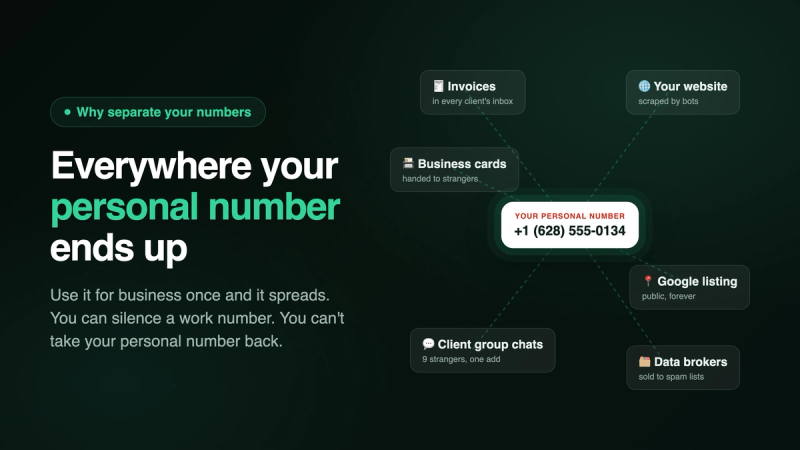
When you're just starting out, giving clients your personal number feels harmless. One client. Two clients. Then it compounds, because a business number doesn't stay between you and the client:
- It goes on invoices. Every invoice you've ever sent is a document with your personal number on it, sitting in someone else's inbox forever.
- It goes on your website and profiles. Portfolio site, Google Business Profile, Etsy shop, Upwork, local directories. Numbers published online get scraped, sold, and spam-called. That's not paranoia; it's the business model of data brokers.
- It ends up in group chats. One client adds you to a project WhatsApp group and suddenly nine strangers have your personal number saved.
- You can never change it. If the spam gets bad or a client crosses a line, you can't exactly get a new personal number. You've had it for years. Your bank, your mum, and 200 contacts depend on it.
And beyond privacy, there are two quieter costs:
Boundaries. When work and life share one number, every buzz after dinner might be work. Research on work-life boundaries keeps finding the same thing: people who can't switch off don't rest properly. A separate line gives you a switch. Work number silenced at 6pm, and the plumber can still reach you.
Professionalism. A dedicated line changes how you answer. When your work number rings, you know it's business, so you pick up with your business voice instead of a confused "...hello?". You look established even if the "office" is your kitchen table. And when a client asks for your number, you hand over a work line without hesitation instead of doing the mental calculation of whether this person seems normal.
If you've already had your fill of this and just want the fix, it's here: get a second number for your business on the App Store. Otherwise, let's talk about what you actually need.
What a Freelancer Actually Needs (Hint: Not a Phone System)
Search for "business phone number" and you'll drown in VoIP phone systems built for teams: call queues, ring groups, extensions, CRM integrations, per-seat pricing. If you have a support team, great. If you're one person with a laptop and a side hustle, you'd be paying business-software prices to solve a personal-boundary problem.
Here's the honest checklist for a freelancer or side hustler:
- A real, dedicated number. Not a shared or recycled one. Your number should be yours alone, so clients can save it, call it, and text it like any normal mobile number, and so verification codes for business sign-ups actually arrive.
- Calls and texts, both directions. Plenty of "virtual number" services are receive-only or text-only. You'll be making outbound calls to clients, so you need the full thing, ideally with picture messaging for sending a quick photo of the job, the product, or the finished work.
- A local number where your clients are. A US number if your clients are American, a UK mobile number if they're British, a Canadian number if they're in Toronto. Local numbers get answered; unfamiliar international formats don't.
- No new hardware, no new SIM. The number should live in an app on your existing phone. No second device to charge, carry, and forget in a taxi.
- The ability to walk away. Side hustles end. You should be able to release the number without cancelling a contract or losing anything that matters.
That's the whole list. Everything else (auto-attendants, extensions, "press 2 for sales") is enterprise cosplay for a one-person business.
If you want the broader lay of the land first, we've written a full guide to how to get a second phone number in 2026, including the traps to avoid with free apps. Short version: free numbers tend to be recycled, flagged as spam, and unreliable for exactly the professional situations where you can't afford it.
How to Set Up a Business Phone Line in About 60 Seconds
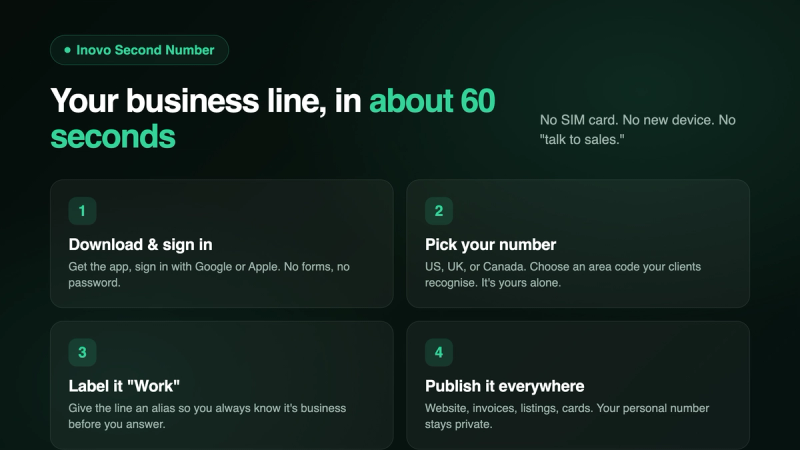
Here's the actual process with Inovo Second Number, start to finish. No SIM card, no contract, no "talk to sales."
Step 1: Download the app and sign in.
Inovo Second Number on the App Store. Sign in with Google or Apple. No forms, no password to invent.
Step 2: Pick your country and browse numbers.
Choose the US, UK, or Canada, then browse the available numbers. Pick an area code your clients will recognise. That number is dedicated to you, not shared with anyone.
Step 3: Label it "Work".
Every number in Inovo gets its own alias. Name this one "Work" (or "Studio", or "Shop") and you'll always know which line is ringing before you answer. This tiny feature is the whole work-life separation, in practice: see "Work" on the screen, answer professionally; see it at 9pm, let it go to rest.
Step 4: Put it everywhere your personal number used to go.
Website, invoices, email signature, business cards, Google Business Profile, marketplace listings, client contracts. From this moment, your personal number stops leaking into the world.
That's it. The number behaves like a normal mobile number because it is one: clients call it and text it normally from their regular phones, with nothing to install on their end. You make calls and send texts (including picture messages) from inside the app over Wi-Fi or mobile data, which also means your work line travels with you. Same US number in a café in Lisbon; your clients never know the difference. If you're curious how that works under the hood, here's how a phone number can exist without a SIM card.
One Phone, Every Hustle
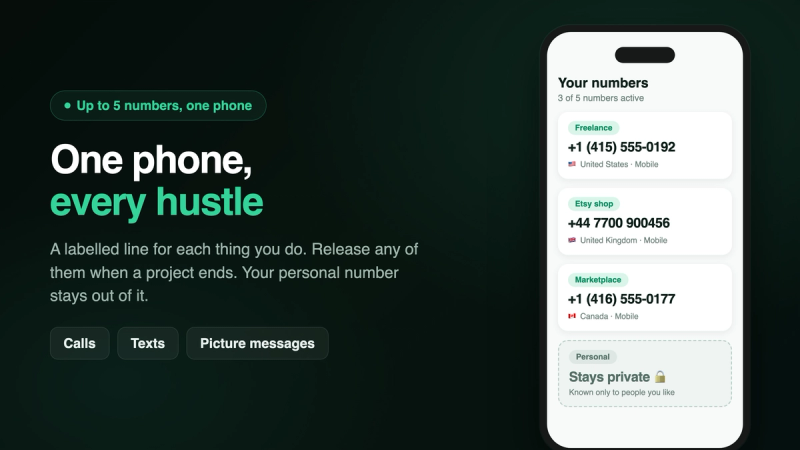
Here's where it gets genuinely useful for the multi-hustle crowd: Inovo lets you hold up to 5 numbers on one phone, each with its own alias.
A realistic setup for someone with a day job and ambitions:
- "Freelance": the number on your portfolio site and invoices
- "Etsy shop": the number attached to your store and its suppliers
- "Marketplace": for selling the flipped furniture (buyers on Facebook Marketplace do not need your real number, ever)
- Personal number: untouched, known only to humans you actually like
Each line is separate. When your side project winds down, release that number and keep the rest. When the freelance business grows, its number keeps working exactly as before. You're running what is effectively a small phone system, except it costs less than a takeaway and lives entirely on the phone in your pocket.
The same separation logic is why we tell people to never put their personal number on selling platforms at all; the full 2026 guide goes deeper on those use cases.
What It Costs (and Why It's Deductible-Shaped)
No per-seat pricing, no contract, no hardware:
- Weekly ($6.99). Good for testing whether the separate-line life suits you, or for a short project.
- Monthly ($19.99). The standard pick for an active freelance line.
- Yearly ($49.99). The obvious choice once the business is real; it works out to about $4.17/month.
Every billing period includes bundled calling and texting credits, and unused credits roll over and never expire. If you have a quiet month, the credits wait for the busy one.
Two practical notes for business use:
- It's a business expense. A phone line used for your business is a legitimate business cost in the US, UK, and Canada. A separate work number makes the paperwork trivially clean compared to arguing about what percentage of your personal phone bill was "business use." (Confirm the specifics with your accountant; we make apps, not tax advice.)
- Cheaper than every alternative. A second handset plus a SIM plan runs $180+ per year on top of the device. Business VoIP systems start around $10-15 per user per month before add-ons. A yearly Inovo plan is $49.99, total.
US, UK, and Canada: The Local-Number Question
Where your clients are decides which number you pick, and this is where most business-number apps fall down: many only offer US numbers.
- US freelancers: pick a number in your metro's area code, or a memorable one from anywhere in the country if you work remotely with clients nationwide.
- UK freelancers: you want a UK mobile number your clients can ring without international charges. (If you've ever looked at Google Voice for this, you already know it doesn't support the UK; we've covered the alternatives that actually work in the UK and Canada.)
- Canadian freelancers: same story. A local Canadian number, callable and textable like any other, without a business Workspace subscription attached.
And because the numbers are real and dedicated, they work for the unglamorous parts of running a business too: registering on freelance platforms, receiving verification texts for business accounts, and being reachable by clients who still, in 2026, like to phone.
The 60-Second Version
If you skimmed here, this is the whole article:
- Your personal number on invoices, websites, and listings is a privacy leak you can't undo, and a boundary you can't enforce.
- You don't need a second phone or a VoIP phone system. You need one real, dedicated number in an app.
- Inovo Second Number gives you a US, UK, or Canadian business line in about 60 seconds: full calls, texts, and picture messages, up to 5 labelled numbers on one phone, from $49.99/year.
- Put the work number everywhere. Keep the personal number for people you'd invite to your birthday.
Get your business number on the App Store
FAQ
Do I really need a separate phone number for freelancing?
Legally, no. Practically, yes, and the earlier the better. Every client, invoice, and public listing that gets your personal number is permanent. Starting with a separate line on day one costs a few dollars; untangling your personal number from your business after two years is close to impossible.
How do I get a business phone number without buying a second phone?
Use a second phone number app. Download Inovo Second Number, sign in with Google or Apple, pick a US, UK, or Canadian number, and it's live on your existing phone in about a minute. No SIM card or extra device is needed; here's how numbers work without a SIM.
Will clients know I'm using an app?
No. To a client it's a normal phone number. They call and text it from their regular phone like any other contact. On your side, calls and texts for that number simply arrive in the app, clearly labelled with the alias you chose.
Can I use the number on my website, invoices, and Google Business Profile?
Yes, that's the point. It's a real, dedicated number, so publish it anywhere you'd publish a phone number. Your personal number stays off the public internet.
What's the best business phone number app for a side hustle?
For a one-person business, prioritise a dedicated (not shared) number, full calling and texting, local numbers in your country, and no long contract. Inovo Second Number checks all four and adds up to 5 separately-labelled numbers on one phone, which suits people juggling a job, a freelance practice, and a shop.
Is a second phone number tax deductible for freelancers?
A phone line used for business is generally a deductible business expense in the US, UK, and Canada, and a dedicated work line makes the record-keeping much cleaner than splitting a personal bill. Confirm your specific situation with an accountant.
What happens to the number if I stop freelancing?
You can release a number whenever you're done with it, and keep any other numbers you still use. Your personal number is never affected; it was never part of the system.
Does this work outside the US, UK, and Canada?
You can use the app from anywhere with an internet connection; the numbers themselves are US, UK, and Canadian. Plenty of freelancers abroad run a US or UK client-facing line this way while living somewhere else entirely.
Inovo Second Number gives you a real US, UK, or Canadian phone number in about 60 seconds. Calls, texts, and picture messages, with your personal number kept private. Download it on the App Store.